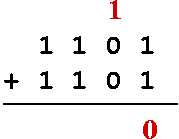
Suppose you want to add two UB 4-bit numbers: x3x2x1x0 and y3y2y1y0.
Here's pseudo-code to add the two numbers:
   int carry = 0 ;
   for ( int i = 0 ; i < N ; i++ )
     {
        int sum = xi + yi + carry ;
        zi = sum % 2 ;
        if ( sum >= 2 )
           carry = 1 ;
     }
Let the rightmost column be column 0, and the leftmost column be column 3.
First, add the right most column (column 0). Summing 1 + 1 results in 0, with a carry of 1 to column 1.
Then, add the two bits in column 1, plus the carry bit. Summing 0 + 0, plus the carry 1, results in 1, with a carry of 0 to column 2.
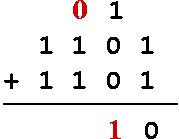
Then, add the two bits in column 2, plus the carry bit. Summing 1 + 1, plus the carry 0, results in 0, with a carry of 1 to column 3.
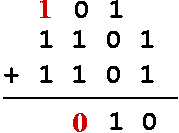
Finally, add the two bits in column 3, plus the carry bit. Summing 1 + 1, plus the carry 1, results in 1, with a carry of 1 to column 4. We've had to "create" a column 4 to place the fifth bit of the sum.
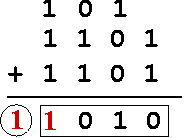
Since we add in hardware, the output usually has the same number of bits as the number of bits being added. Since we were adding two 4-bit UB numbers, the result should be a 4-bit result.
Thus, the additional bit in column 4 (which is circled) is often discarded, or used to detect overflow. The answer is the 4-bit result, drawn inside the rectangle.
If the sum of two k-bit UB numbers causes a carry out of 1 into column k (as it did in the example above), there is overflow.